
News
Integrating sales, warehousing, processing, distribution, and export, we are dedicated to meeting our customers' steel supply chain needs.
Main Classifications of Greenhouses
I. Classification by Covering Material
1. Film Greenhouse
Covering Material: Single or multi-layer films such as polyethylene (PE), polyolefin (PO), and EVA film.
Structural Forms: Single-span arched greenhouses, multi-span film greenhouses.
Global Distribution: Cost-sensitive regions such as China, Southeast Asia, Africa, South America, and Eastern Europe.
Features: Lowest cost, quick installation, lifespan 1-5 years (depending on film quality).
Applications: General commercial production such as vegetables, fruits, and cut flowers.
2. Polycarbonate Sheet (PC Sheet) Greenhouse
Covering Material: Hollow or solid polycarbonate sheets, thickness 4-16mm.
Structural Forms: Mainly multi-span.
Global Distribution: Mid-to-high-end projects in Europe, North America, Japan, the Middle East, and China.
Features: Impact resistant, better heat retention than film, light transmittance around 80%, lifespan 10-15 years, lightweight.
Applications: High-end flowers, eco-restaurants, seedling cultivation, and agricultural tourism. 3. Glass Greenhouse
Covering Materials: Single or double-layer float glass, tempered glass, diffused glass.
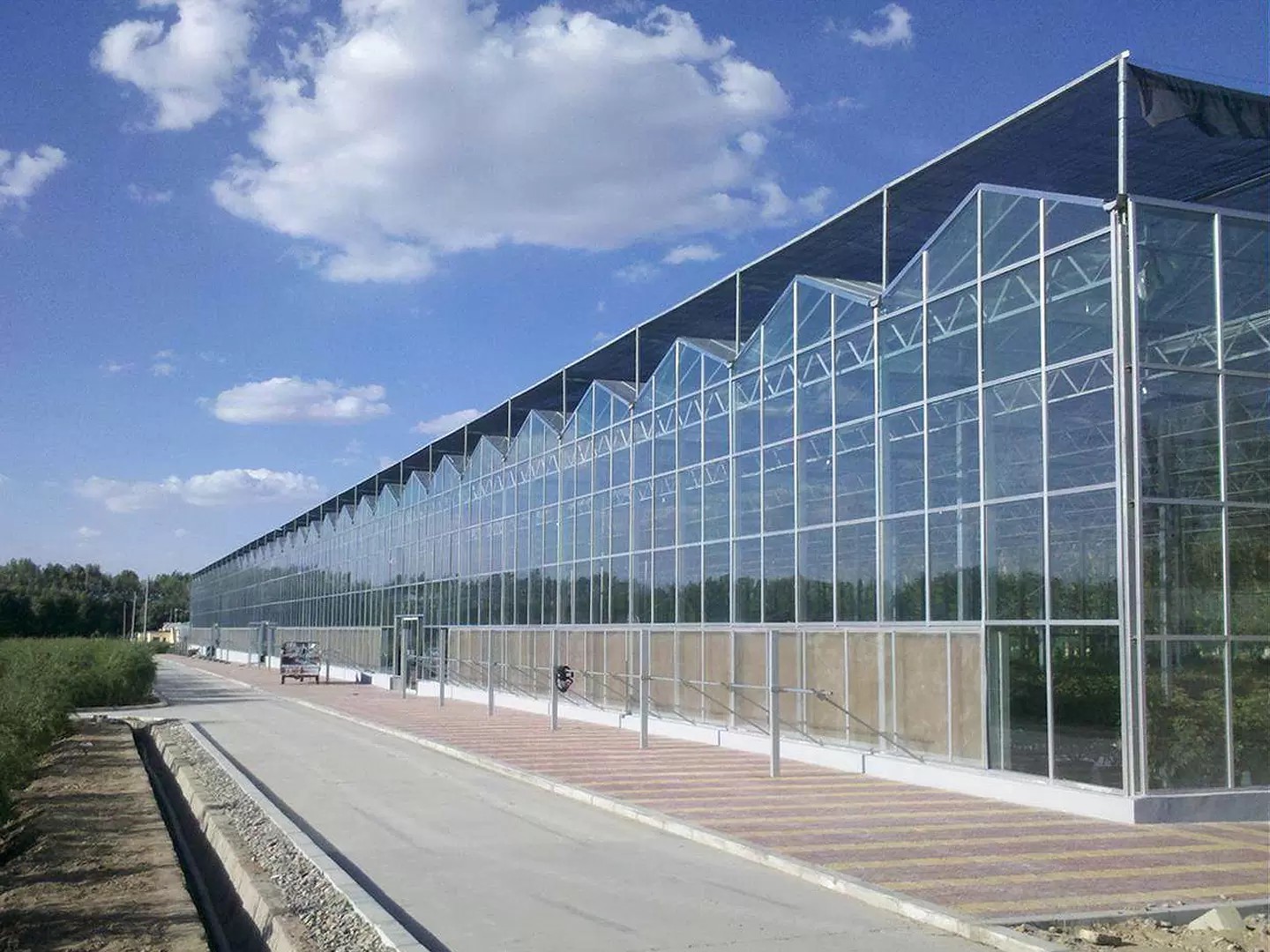
Structural Form: The mainstream type is the multi-span Venlo type, originating from the Netherlands.
Global Distribution: Netherlands, Northern Europe, North America, Japan, Russia, and high-end markets in the Middle East.
Features: Highest light transmittance (over 90%), lifespan over 20 years, precise environmental control, extremely high investment.
Applications: High-value-added vegetables (tomatoes, bell peppers), flowers, plant factories, research institutions.
II. Classification by Structure and Environmental Control System
1. Simple/Passive Greenhouse
Characteristics: No active environmental control (heating, fans, evaporative cooling pads). Relies solely on film/sheet covering and natural ventilation.
Typical Examples: Chinese plastic greenhouses, simple arched greenhouses in Africa, low-cost greenhouses in South America.
Applications: Low-cost production, temperate climate zones.
2. Active Ventilation Greenhouse
Features: Equipped with fans, evaporative cooling pads, top windows, and side windows for active cooling and ventilation.
Common Forms: Multi-span film greenhouses, PC panel greenhouses.
Suitable for: Subtropical and tropical regions, such as India, Southeast Asia, and the southern United States.
3. Semi-Enclosed Greenhouse
Features: Increases air circulation and positive/negative pressure ventilation compared to active ventilation greenhouses, resulting in more uniform temperature and humidity.
Typical Examples: Dutch-style semi-enclosed greenhouses, Israeli-modified greenhouses.
Suitable for: Regions with hot summers, such as the Middle East, Southern Europe, and California, USA.
4. Fully Enclosed Greenhouse / Artificial Light Plant Factory
Features: Completely sealed, uses artificial light (LED), multi-layered vertical cultivation, and fully controlled environment.
Global Representatives: Japan, the United States, Singapore, and Northern Europe.
Suitable for: High-value-added crops, urban agriculture, and extreme climate regions (deserts, polar regions).
III. Classification by Climate Adaptability
**Design Focus:** Insulation, double-layer or double-film PC panels, active heating system, snow load protection.
**Typical Regions:** Canada, Russia, Northern Europe, Northern China, Hokkaido, Japan.
**Common Types:** Dutch-style glass greenhouse, double-layer inflatable greenhouse.
2. Temperate Climate Greenhouse
**Design Focus:** Balancing insulation and ventilation; can be equipped with heating and evaporative cooling pads/fans.
**Typical Regions:** Western Europe, North-Central United States, North China, South Korea.
**Common Types:** Venlo glass greenhouse, multi-span PC panel greenhouse.
3. Subtropical/Arid/Semi-Arid Greenhouse
**Design Focus:** Shading under strong sunlight, efficient cooling (evaporative cooling pads + fans, misting), UV-resistant covering materials.
**Typical Regions:** Mediterranean coast (Spain, Italy), Southwestern United States, Australia, Middle East, North Africa.
**Common Types:** Spanish-style "multi-tunnel" greenhouse (with shading and roll-up curtains), high-roof multi-span film greenhouse.
4. Tropical/High Temperature and Humidity Greenhouse
Design Focus: Maximum ventilation (fully open roof windows), condensation prevention, resistance to strong winds/typhoons.
Typical Regions: Southeast Asia, India, Central America, West Africa.
Common Types: High arched sheds, multi-span film greenhouses with fully open sides.
IV. Classification by Special Purpose
1. Seedling Greenhouse
Features: Equipped with movable seedbeds, misting systems, and supplemental lighting; commonly used in commercial seedbeds.
Covering Materials: Primarily glass or PC panels.
2. Production Greenhouse (Commercial Harvesting)
Features: High ceilings, vine hanging systems, harvesting tracks, integrated water and fertilizer management.
Typical: Tomato, bell pepper, cucumber, rose greenhouses.
3. Research/Teaching Greenhouse
Features: Zoned isolation, artificial climate chamber modules, high-precision sensors.
Users: Universities, research institutes, breeding companies.
4. Ecological Restaurant/Sightseeing Greenhouse
Features: Large span, high light transmittance, aesthetically pleasing design, interior landscaping possible. Common coverings: PC board or glass.
Leave a Message
Thank you for your interest in our products. "*" Indicates the Fields are Mandatory